ChargerLAB POWER-Z KM003C: hardware notes
Links such as S2 point to the Sources list.
1. Overview and specs
The KM003C is the successor to the KM002C. ChargerLAB says the KM002C "was discontinued due to the shortage of chips" S1. The KM003C is an in-line USB-C power meter and PD analyzer/trigger. It has a USB-C plug, a USB-C receptacle and a third USB-C port labelled "HID", which powers the unit and connects it to a PC O S1 S2 S6.
| Spec | Value | Source |
|---|---|---|
| Size / weight | 36.5 × 35.5 × 8.7 mm, 16.5 g | O S1 S5 |
| Display | 1.54" IPS, 240×240 | O S1 S3 S5 |
| Ports | USB-C plug and USB-C receptacle (both "support USB4 Gen3, bidirectional"), plus a USB-C "HID" port for PC and power | O S2 S3 S6 |
| HID port | USB-C (5 V). It is the only port that talks to the PC | O S1 S10 |
| VBUS range | 0–50 V continuous; 6 A continuous and instantaneous | O S2 (spec table) |
| Marketing rating | "up to 50V 6A (240W in PD)" | O S3 S1 |
| D+/D− and CC1/CC2 withstand | 50 V (the D+/D− figure is footnoted "technically supported without enough experiments") | O S2 |
| Port internal resistance | "About 20 mΩ" (the KM002C is about 28 mΩ) | O S1 S5 |
| Typical operating current | 15–50 mA (the KM002C is 8–25 mA) | O S1 S5 |
| Input impedance / anti-surge | >800 kΩ / 4 kV | O S2 |
| Operating / storage temperature | −10 to +65 °C / −45 to +110 °C | O S2 |
| Processor / ADC | "This tester integrates ARM Cortex-M4 processor and 20 bit ADC" | O S3; 20-bit ADC also in S1 S2 |
| PC data volume | "The PC software can obtain 10 million pieces of data at a time" | O S3 |
| Storage | "4MB Flash"; "Capacity 4MB" | O S2 S1 |
| Gravity sensor (auto-rotate) | Yes | O S1 S3 |
| Supercapacitor | Yes; "can run for five to ten seconds after disconnecting" | O S1 |
| Reverse-polarity protection | None. "The USB tester has no reverse voltage protection" | O S2 |
| Languages | English / Chinese | O S1 S3 |
| Price | $109.99 | O S1 S3 |
Known hardware quirks
- USB 2.0 passthrough. The FAQ says some USB 2.0 devices "(Like mouse, keyboard)" fail through the tester: "It is a hardware issue ... the internal module has affected the USB2.0 devices. The USB3.0, USB3.1, USB3.2 and USB4 devices can work normally." O S4. AnandTech also says ChargerLAB acknowledged this as a hardware design bug 3P S20.
- Plug solder joints. A hobbyist teardown found that the solder joints of the male plug's top-side pins lift from the PCB. A unit made in 2023-11 had extra solder added at that spot 3P S17.
- PD3.2. The product page now says "This tester is the latest version and can support PD3.2" O S3. PD 3.2 features arrived through firmware and PC-software updates (see §5). I found no evidence of a hardware revision for PD3.2 I.
2. Components
| Part | Function / notes | Evidence and source |
|---|---|---|
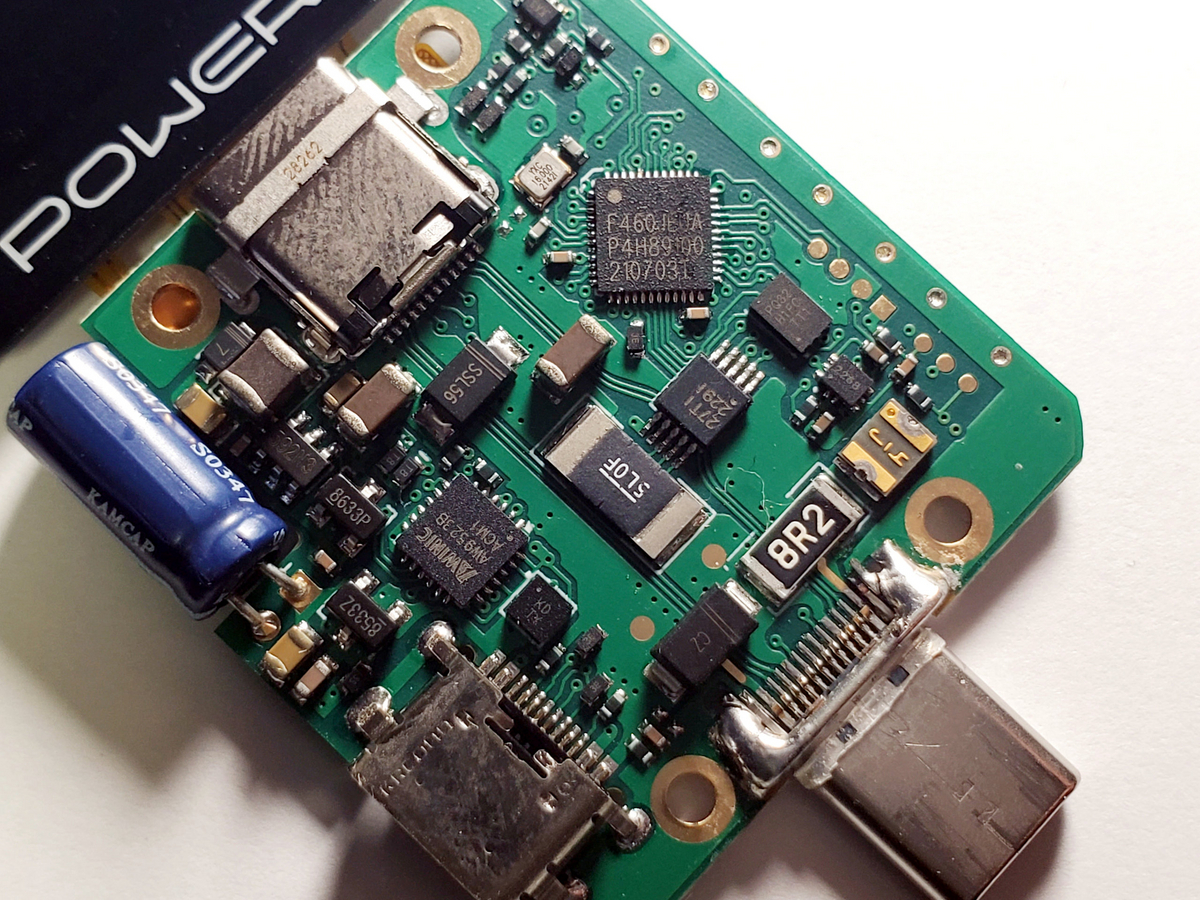
HDSC (Huada) HC32F460, marking F460JETA (HC32F460JETA, LQFP48) | Main MCU: Arm Cortex-M4F, 512 KB flash, 192 KB SRAM, 4 KB retention RAM | 3P The teardown author names "Huada HDSC HC32F460" and its specs S17. C The F460JETA marking is read from the photo, and the firmware matches the HC32F460 register map S19. 3P AnandTech names the same MCU, but only by inference from a KM002C photo S20. O says only "ARM Cortex-M4" S3 |
| MCU clock | Configured to 192 MHz from a 16 MHz input | C firmware/register analysis S19. I I read "YXC 16.000" on a crystal in the teardown photo S17 |
| TI INA229 | 20-bit power monitor (VBUS/IBUS, die temperature) on SPI2 | C Photo marking "229", plus manufacturer/device IDs 0x5449/0x2291 read over SPI on HW2.1 S19. O says only "Built-in 20-bit ADC (high-precision measurement IC)" S2 |
| TI INA228 (claimed) | 20-bit I²C power monitor | O ChargerLAB's INA228 article is about the KM002C S11. 3P AnandTech says "The INA228 in the KM003C has a 20-bit ADC", but this rests on the KM002C photo S20. For the KM003C, the evidence points to INA229 instead |
| ADC temperature sensor | PC software: "T1 ... is ADC chip temperature, accuracy ±1°C"; "T2 is microcontroller temperature, accuracy ±5°C" | O S4 |
| MCU internal ADC1 | D+, D−, CC1, CC2 voltages (pads PA0–PA3) | C S19 (docs/line-adc.md). AnandTech guessed "at least 5 ADCs" 3P S20 |
| Current shunt | Value not confirmed.
| O S2 S5; 3P S20; C S19; I S17 |
| Current sense amplifier | Built into the INA229 (no separate amplifier identified) | C / I S19 |
| USB-PD PHY / CC controller | No dedicated PD PHY chip identified. The community finds that PD runs on HC32F460 peripherals: CMP1 comparator with a DAC1 reference for receive, and TimerA2 with DMA for transmit, plus external analog parts. CC Rd is switched by MCU GPIO PB6 and AW9523B P0_3. ChargerLAB does not document this | C S19 (README, pd_phy_hc32f460.md, board_bringup.md) |
| USB device controller | HC32F460 on-chip Synopsys DWC2-compatible USB FS OTG with internal PHY (PA11/PA12) | C S18 S19 |
| Display | 1.54" IPS 240×240. Controller is ST7789-compatible on a QSPI bus shared with the flash. A 240×240 ST7789 replacement panel was reported to work | O S1; C S18 S19; the replacement report is cited via S19 from S23 (not read) |
| AWINIC AW9523B | I²C GPIO/LED expander at 0x5B (panel reset, backlight, CC2 Rd control) | C Marking visible in the teardown photo, and register sequences match S19 S17 |
| SC7A20-family accelerometer | Auto-rotation ("gravity sensor"); I²C 0x19, WHO_AM_I 0x11 | C S18 S19; O confirms a gravity sensor exists S1 |
| External flash | 4 MiB NOR (legacy ID 0x8515; exact part unknown). Holds factory settings and calibration at 0x3FF100. I It presumably also holds the offline records counted in the official "4MB Flash" | C S18 S19; O S2 |
| Supercapacitor | KAMCAP 3.0 V 0.35 F | 3P teardown S17 |
| Built-in load | ChargerLAB credits MTK-PE/VOOC/SVOOC detection to a "built-in load". I An "8R2" (8.2 Ω?) power resistor is visible in the photo; its function is unverified | O S1; I S17 |
| Crypto / auth chip | None identified. Firmware updates (.mencrypt) and the PC-streaming authentication use AES-128-ECB. The community attributes this to software and the HC32F460's on-chip AES block. The authentication checks the MCU unique ID at 0x40010450 | C S18 (docs/firmware/format.md, docs/features/authentication.md), S19 (overview.md) |
| Bootloader | Native DFU loader in internal flash below 0x4000 C. Official: Back "Press and hold it when power off, you can enter the DFU mode" O. Community: hold Exit/Back while connecting power to the HID port C | S2 S6 S18 S19 |
Other markings visible in the teardown photo that I could not identify I: "SSL56" (likely a Schottky), "8633P", "85337", "2268" (8-pin) and "PQ82/H1PC" (power package). The photo is linked at S17.
3. Schematic and teardown availability
- Schematic: not found in the searches I ran (chargerlab.com, power-z.com, power-z.cn, general web, GitHub). No schematic is inferred here. The community firmware repo has an MCU pad inventory, but it says "This is a complete MCU-pad inventory, not a fully traced board schematic" C S19.
- ChargerLAB / chongdiantou (充电头网) teardown of the KM003C itself: not found. ChargerLAB uses the KM003C as a tool in many charger teardowns. Its only "internals" statement is the KM002C INA228 article O S11.
- EEVblog / bilibili / YouTube KM003C teardown: not found in the searches performed.
- Hobbyist teardown, found. tomoca2's blog (Japanese), "結局、分解補修したPOWER-Z KM003C" (2024-01-06). It has photos of both PCB sides and a close-up of the component side. It names the HC32F460, shows a KAMCAP 3.0 V 0.35 F supercap, and dates the PCB to 2022-09-12 3P S17.
- Community bring-up docs. okhsunrog's
km003c-firmwarehas pinout and peripheral tables from register reads on a live HW2.1 unit, plus decompiled stock firmware 1.9.9 and 2.0.7 C S19. - AnandTech review (2023), read via a Wayback Machine snapshot from 2024-03-01. The live site now redirects to its forums. It says: "Based on the photograph of the KM002C's PCB ... the main differences appear to be the use of a Huada HDSC HC32F460 microcontroller, multiple INA228 ADCs, and 20 mOhm shunt resistors." These are inferences about the KM003C drawn from a KM002C board, and the INA228 part conflicts with the INA229 evidence above 3P S20.
4. Measurement capabilities
Ranges, resolution and accuracy (official figures, quoted as published)
| Figure | Value | Source |
|---|---|---|
| Voltage / current range | 0–50 V / 0–6 A | O S2 S5 |
| Voltage / current resolution | 0.000001 V / 0.000001 A (1 µV / 1 µA display digits) | O S5 (2024.1 comparison chart) |
| Accuracy (chart) | "0.1%+2d" | O S5 |
| "Voltage Accuracy" / "Current Accuracy" (manual table) | 0.00002 V / 0.000003 A | O S2 |
| Voltage / current gain error (manual table) | "0.05 0.25 %" (two columns, no headers; probably typ/max) | O S2 |
| Gain error vs temperature | "5 20 ppm/°C" (same two-column layout) | O S2 |
| "Accuracy" (launch comparison image) | "0.00003" (no unit given) | O S1 |
| ADC bits | 20 | O S1 S2 S3 |
| Bidirectional current | Yes. The display shows a direction arrow, and the Linux driver reports direction as the sign of curr1_input (label IBUS) | O S12; 3P S16 |
| Wire units (official API) | Vbus/Ibus as int32 in µV / µA; CC1/CC2/D+/D−/Vdd as uint16 at 0.1 mV; also raw (uncalibrated) averages, internal temperature and a 2-bit Rate field | O S14 (KM002C&3C API Description.docx) |
| Averaged vs instantaneous values | AnandTech found the API's Vbus_avg/Ibus_avg change "only once every second". The instantaneous values are "the first two words in the returned ADC data struct" | 3P S20 (page 3) |
The official accuracy figures disagree across documents (0.1%+2d; 20 µV / 3 µA; 0.00003). None is clearly labelled as reading accuracy versus resolution. A client should not hard-code an accuracy claim.
Sample rates, by context
No single official list exists. Each context reports something different:
| Context | Rates | Source |
|---|---|---|
| Manual, "Features" section | "Data Collection: Up to 1,000 times per second"; "Programmable Collection Speed: 1/10/50/100 times per second" | O S2 |
| On-device Dashboard refresh | "2/10/50/1k Hz" (manual) vs "4sps, 15sps, 60sps, and 1Ksps" (2024 "10 functions" article) | O S2 vs S6 |
| PC software (V2.x) recorder | "1SPS, 10SPS, 50SPS and 1KSPS". The cache depth is configurable up to 1999 MB, about 19.99 M points. AnandTech saw the same rates: "Available rates are 1, 10, 50, and 1000 samples per second" | O S7; 3P S20 |
| PC software V2.5.1 changelog (2026-04-16) | "Added a notice that 200 SPS may affect protocol control functionality". This implies a 200 SPS option in recent PC software; I found no other documentation of it | O S2 |
| POWER-Z Lab V3.0 (beta) | "Sampling Rate (Adjustable from 0.1–1K SPS)". Sub-1 SPS is probably host-side decimation I | O S10 |
| Temperature channel | PC 2.1.0: internal temperature monitoring is "only valid for 1/10/50 SPS" | O S2 |
| Community wire protocol (StartGraph rate index) | 0 = 2 SPS, 1 = 10 SPS, 2 = 50 SPS, 3 = 1000 SPS. Measured effective rates were about 1.8 / 9.6 / 47 / 956 SPS | C S18 (docs/features/adcqueue.md) |
| Plain ADC snapshot polling | ~200 ms (~5 Hz) in community captures. AnandTech polled every 100 ms | C S18; 3P S20 |
| 10 kSPS | No official claim found. The official API header defines ATT_ADC_QUEUE_10K = 0x004 //10K数据 ("10K data"), but the community reports it "never observed in 20k+ packets, including 1000 SPS runs" | O S14; C S18 |
| VBUS ripple module (separate on-device feature) | Selectable "20.0k 1250μs to 8.0M 3μs" sample rates | O S2 S6 |
Offline (stand-alone) recording
- The unit records V/I/capacity/energy to its 4 MB flash without a PC. The PC software reads and exports the records O S2 S7.
- Up to 40 record groups. Each group holds at most 10,000 points. The save interval is 1–120 s (5 s gives about 13 h). Auto start and stop can trigger on a current threshold O S2. The 2024 chart says "Group Number for Offline Recording: 15-40" O S5.
- Firmware V2.0.0 "Optimized offline curve logging". V2.0.1 and V2.0.6 fixed offline-reading bugs O S8 S9.
5. Protocol detection and PD features
Auto-detection (KM003C), from the manual: PD2.0 / PD2.0 PPS / PD3.1 (EPR) / QC2.0 / QC3.0 / QC3+ / QC4+ / QC5 / AFC / FCP / SCP / VIFC / UFCS / APPLE2.4A / SAMSUNG / VOOC / MTK PE / SFCP / TFCP O S2. MTK-PE, VOOC and SVOOC detection is "thanks to built-in load" and is KM003C-only O S1 S2. The 2024 article's list also names SVOOC O S6.
Trigger, on-device ("Application → Charging protocol"): PD2.0 / PPS / EPR / QC2.0 / QC3.0 / AFC / FCP / SCP / VIFC / UFCS / VOOC. VOOC/SVOOC needs the original cable and a small load. MTK PE and SFCP cannot be triggered O S2 S6.
Trigger from PC (firmware ≥1.7.9 with PC 2.3.0): PD (up to 28 V 5 A shown), UFCS, QC2.0/3.0, FCP, SCP, AFC, VFCP, SFCP O S13. ChargerLAB also documents triggering over the CDC virtual serial port in "KM003C/002C Protocol Trigger by Virtual Serial Port (Instructions)". The manual and FAQ name this document O S2 S4. I read it from the community-hosted copy (S18 docs/official/); §6 summarizes it.
PD features
- PD protocol analyzer / packet capture. It was added in firmware 1.2.4 and PC 2.0.3. It captures SOP/SOP'/SOP'' packets. The manual says the PC analyzer holds "up to 10,000 pieces of data" O S2.
- UFCS protocol analyzer (FW 1.7.1, PC 2.2) and UFCS 1.2 capture (PC 2.5.0) O S2.
- PD 3.2: SPR AVS added in FW 1.9.2. PD 3.2 packet capture came in PC 2.5.0, and PD 3.2 identification on the Dashboard in FW 2.0.7 O S2 S8.
- EPR / PD3.1: supported throughout. A 240 W cable is needed for EPR unless cable simulation is used O S2.
- Cable simulation (decoy e-marker). The tester can "simulate a 50V/5A cable". Since FW 1.9.7 the default is 50 V 5 A (240 W, EPR) O S2 S9.
- PDM application. FW 2.0.5 "Added support for sending and receiving custom PD data through the PDM application" O S9.
- eMarker reader. Reads 3A/5A/50V/EPR/TBT3/TBT4 cables, and Thunderbolt 5 since FW 1.9.3. The eMarker IC model has been identified since FW 2.0.0 (HUSB332x, CPS8825/8826, WAYON and others) O S2 S8 S9.
- Apple charger SN reading. Apple device model and Huawei power-bank battery display arrived in FW 2.0.0 O S6 S9.
- The Dashboard shows a "possible" protocol from D+/D− voltage levels. The manual includes a D+/D− voltage → protocol table O S2.
Firmware history (tester)
Full list in S2 and S9. Highlights:
- 1.2.x (2022)
- 1.6.4: Xiaomi MIPPS
- 1.7.1: UFCS analyzer, SVOOC 160/240 W
- 1.7.9: PC trigger module
- 1.8.0: VBUS ripple, Motorola/Huawei protocols
- 1.8.6: Infinix TFCP
- 1.9.2: PD3.2 SPR AVS
- 1.9.3: Thunderbolt 5 cable identification
- 1.9.7, 1.9.8, 1.9.9
- 2.0.0 (2026-03-26): eMarker IC model, Apple device models
- 2.0.1, 2.0.2, 2.0.3, 2.0.5, 2.0.6
- 2.0.7 (2026-09-29), latest found
6. Software, SDK and USB interfaces
PC software
- "POWER-Z" PC software, V2.x. It is Windows-only in practice.
- The executable is
Mtools. Gigazine installs "Mtools" from "(V2.3.0) PE version - PC Software (KM002C/KM003C).zip" 3P S21, and the community found it is a Qt5 x64 app,Mtools.exeC S18. - Latest version per the manual: V2.5.1 (2026-04-16) O S2.
- Functions: real-time curves, recording (CSV / SQLite
.dbexport), PD/UFCS analyzer, protocol trigger, firmware update, and many testers at once O S6 S7. - The FAQ says it supports "Windows 10 or later". PC 2.2.1 "Integrate[d] the support of Windows 7" O S2 S4. AnandTech: "The KM003C supports only Windows officially" 3P S20.
- The executable is
- POWER-Z Lab V3.0 Beta (2025-03-19). Windows 7/10/11 and macOS, distributed via a Telegram link.
- It requires tester firmware 2.0.0, and its recordings are
.pzdfiles. - Known bugs: no offline-data viewing on Mac, and FW 2.0.0 cannot read eMarkers.
- As of March 2025, ChargerLAB recommended "the more stable and feature-complete V2.4.0" for most users O S10.
- The "2.0.0" bundled with this 2025 beta predates the public V2.0.0 changelog entry (2026-03-26) by a year, and that entry adds eMarker IC reading. It is probably a different pre-release build I.
- It requires tester firmware 2.0.0, and its recordings are
- Firmware updates run through the PC app, which "will erase the old firmware and write the new one". The files are
.mencryptO S8 S10. The community reports the format is AES-128-ECB encrypted Qt-serialized metadata plus the image, with the application at flash 0x4000 C S18.
Download URLs seen on official pages
The official product page S3 has no direct download links. It says "Please go to our official website to get the manual and PC software", and its navigation leads to the KM003C Technical Support page S4, where most of these links appear. I downloaded only the API toolkit (to read its source and docx) and the driver zip (file listing only). The software-re agent is handling the binaries.
Official API / SDK
- FAQ: "Are there any open APIs available for further self-development? ... We currently only provide limited toolkit for reference." It links
hiddemo_vs2019_for KM002C&3Cand names a "Protocol Trigger by Virtual Serial Port" document O S4. The manual's feature list still says "Provide open API" O S2. hiddemo_vs2019_for-KM002C3C.zipO S14 contains a C++ libusb-1.0 demo (hiddemo.cpp) and a Chinese spec,KM002C&3C API Description.docx, titled "Km002c接口说明" (KM002C interface description).- The demo opens VID
0x5FC9with PID argument0x0000, which matches any PID, so it does not confirm0x0063. A commented-out line uses PID0x0061. The demo also counts devices with VID0x5558(purpose unknown). - It claims every interface and treats interrupt endpoints as "HID" and bulk endpoints as "user". It polls
CMD_GET_DATAwithATT_ADCevery 150 ms. - AnandTech sent the same GET_DATA/ADC command word (
0x0C000200) from Python/pyusb on EP0x01and read the reply on0x81. It also sent the command as a string over the Windows COM port. It found that the ID byte "could be varied from 0x0 to 0xFF without any loss in functionality" 3P S20.
- The demo opens VID
- Virtual serial port (CDC) text commands. This is official and requires FW ≥1.7.9 per S2. Commands are plain-text lines for the protocol-trigger ("PDM") module O (copy at S18
docs/official/KM003C_002C Protocol Trigger by Virtual Serial Port (Instructions).docx):pdm open/pdm closepdm set type=?,em=?, whereemis cable simulation: 0 off, 1 20V5A, 2 50V5A EPRentry pd|ufcs|qc|fcp|scp|afc|vfcp|sfcppd pdo,pd req=?,volt=?,cur=?(PPS/AVS),pd cmd=?,pd data=…(raw SOP + header + data)qc 9V,qc3 volt=…,ufcs req=…, and similarreset
- No official SDK or library beyond this. ChargerLAB acknowledges the community Linux driver: "Some enthusiasts developed a 'HWMON POWER-Z driver' for linux, but we are not responsible..." O S4.
- Linux kernel
powerzhwmon driver (author Thomas Weißschuh). Supported chip: "ChargerLAB POWER-Z KM003C". It "communicates with the custom protocol over USB" and exposes channels named as on the device and PC software 3P S16. The patch was posted in September 2023. The driver's page exists in the kernel.org docs for v6.7 but not v6.6, which suggests it first shipped in Linux 6.7 3P S16 I. - Community implementations:
km003c-protocol-research(Python + Rust parser, protocol spec, USB captures) andkm003c-rsC S18. There is also a custom Rust firmware for HW2.1 C S19.
USB interfaces
Official: the API description docx O S14 (translated) says the device offers three interfaces with one command set:
- USER: called WinUSB on Windows and "USB USER" elsewhere; about 200 KB/s.
- CDC virtual serial: baud rate ignored; about 200 KB/s; works with any serial terminal.
- HID: needs no driver on any platform; 64-byte packet limit; about 60 KB/s.
The manual summarizes this as "Composite USB port, driver-free" O S2. AnandTech restates the three interfaces ("WinUSB (vendor specific interface) device, a HID device, or a virtual serial port (CDC)"). On their 2023 Ubuntu 20.04 setup only the HID interface was bound (to usbhid), and no /dev/ttyACM0 appeared 3P S20.
Naming caution: in ChargerLAB documents, "HID" is also the name of the physical USB-C port used for PC and power. "Connect via the HID port" therefore does not mean the PC software uses the HID class O S2 S10.
Community descriptor dump (HW2.1) C S18 docs/usb_transport.md:
| Property | Value |
|---|---|
| Device | USB 2.10, Full Speed, class 0xEF (IAD), 100 mA |
| Family PIDs | KM002C 0x0061, KM003C 0x0063 |
| IF0 | Vendor 0xFF, bulk EP 0x01 OUT / 0x81 IN, 64 B. Linux binds powerz here |
| IF1 | CDC ACM, EP 0x83 interrupt IN, 8 B |
| IF2 | CDC Data, bulk EP 0x02 / 0x82, 64 B. Linux binds cdc_acm to IF1+IF2 (/dev/ttyACM*) |
| IF3 | HID 1.11, interrupt EP 0x05 / 0x85, 64 B, 1 ms. Linux binds usbhid (/dev/hidraw*) |
| BOS | Platform capability UUID {d8dd60df-4589-4cc7-9cd2-659d9e648a9f} with a 170-byte vendor-request blob. I This UUID is the Microsoft OS 2.0 descriptor capability, which lets Windows bind WinUSB automatically. That would fit the "driver-free" claim, but it is unverified |
Endpoint discrepancy: AnandTech wrote that ChargerLAB says commands can also go to "EP 5 OUT and EP 3 OUT ... at addresses 0x5 and 0x3" 3P S20. The community dump puts the CDC data OUT endpoint at 0x02 and has no 0x03 OUT. The firmware may have changed, or one source is wrong; this is unresolved I.
Which interface the official app uses is not documented by ChargerLAB.
- The community reports that the authenticated AdcQueue streaming (needed for 50/1000 SPS graphs) works only on IF0, the vendor bulk interface.
Mtools.execontains the streaming-authentication routine. HID gives basic ADC and PD access but not authenticated streaming C S18. - AnandTech captured the official app's traffic with Wireshark/USBPcap but did not name the interface 3P S20.
- ChargerLAB ships a driver installer O S4 S15.
Together this suggests the PC app uses the vendor/WinUSB interface (IF0) I.
7. Notes for a CLI client (summary of the above)
- Use VID
0x5FC9, PID0x0063(KM002C is0x0061) C S18. - On Linux, the in-kernel
powerzdriver claims IF0. Unbind it, or use the hwmon sysfs values 3P S16 C S18. - Offer the rate set 2 / 10 / 50 / 1000 SPS as the device-native streaming rates C S18.
- Values arrive in µV / µA (int32; signed current gives direction) O S14.
- Temperature arrives only in the ADC snapshot, not in the stream C S18. The official app shows it only at 1/10/50 SPS O S2.
- PD/QC/UFCS triggering can be scripted over the CDC serial port with the official text commands in §6 O.
- The tester resets if it is powered from the measured VBUS and VBUS drops to vSafe0V. Power it from the HID port 3P KM002C S22; O S2.
Sources
- S1 ChargerLAB, "Introducing the Brand New POWER-Z KM003C" (2022-11-16): https://www.chargerlab.com/introducing-the-brand-new-power-z-km003c/. Spec images: key specifications, KM003C vs KM002C, PDO/protocol test
- S2 Official online manual, "ChargerLAB POWER-Z KM003C/KM002C USB Tester User Manual". It includes the version history, spec table, protocol lists and storage limits, and is linked from S4: https://docs.google.com/document/d/1T55UeixUNN9La3tzAF0jO45Snw_rrd9RVGt3XQeRIM8
- S3 Official product page, POWER-Z store, "ChargerLAB POWER-Z KM003C": https://www.power-z.com/products/chargerlab-power-z-km003c
- S4 POWER-Z KM003C/KM002C Technical Support (FAQ, downloads, API toolkit, driver): https://www.power-z.com/blogs/technical-support/power-z-km003c-km002c-technical-support
- S5 "Comparison of ChargerLAB POWER-Z USB PD Testers (2024.1)" chart, linked from chargerlab.com/power-z-technical-support: https://www.chargerlab.com/wp-content/uploads/2024/01/2024011906294954.png
- S6 ChargerLAB, "Inventory of 10 Commonly Used Functions of Power-Z KM003C" (2024-02-12): https://www.chargerlab.com/inventory-of-10-commonly-used-functions-of-power-z-km003c/
- S7 ChargerLAB, "How to Use ChargerLAB POWER-Z KM003C Tester to Record Charging Data" (2023-02-13): https://www.chargerlab.com/how-to-use-chargerlab-power-z-km003c-tester-to-record-charging-data-offline/
- S8 ChargerLAB, "V.2.0.7 | The New Software Version of ChargerLAB POWER-Z KM003C" (2026-09-30): https://www.chargerlab.com/v207-the-new-software-version-of-chargerlab-power-z-km003c/
- S9 ChargerLAB, "V.2.0.6 …" (2026-08-10, version history back to 1.8.0): https://www.chargerlab.com/v206-the-new-software-version-of-chargerlab-power-z-km003c/. Also V2.0.5 and V1.9.9
- S10 ChargerLAB, "ChargerLAB POWER-Z Lab V3.0 Beta: Now Available for Mac!" (2025-03-19): https://www.chargerlab.com/chargerlab-power-z-lab-v3-0-beta-now-available-for-mac/
- S11 ChargerLAB, "ChargerLAB POWER-Z KM002C PD3.1 Tester Adopts The TI INA228" (2022-08-19): https://www.chargerlab.com/chargerlab-power-z-km002c-pd3-1-tester-adopts-the-ti-ina228/
- S12 ChargerLAB, "Bi-directional Current Detection | … KM003C" (2023-05-11): https://www.chargerlab.com/bi-directional-current-detection-the-cool-feature-of-chargerlab-power-z-km003c/
- S13 ChargerLAB, "Protocol Trigger Module on PC | The New Update of POWER-Z KM003C/2C" (2023-08-13): https://www.chargerlab.com/protocol-trigger-feature-on-pc-the-new-update-of-power-z-km003c-2c/
- S14 Official API toolkit
hiddemo_vs2019_for-KM002C3C.zip(hiddemo.cpp,KM002C&3C API Description.docx): https://www.chargerlab.com/wp-content/uploads/2019/05/hiddemo_vs2019_for-KM002C3C.zip - S15 Official Windows driver installer: https://www.chargerlab.com/wp-content/uploads/2022/07/InstallDriver.zip
- S16 Linux kernel, "Kernel driver POWERZ": https://docs.kernel.org/hwmon/powerz.html. v6.7 copy: https://www.kernel.org/doc/html/v6.7/_sources/hwmon/powerz.rst.txt (the v6.6 URL returns 404). Patch v3 (2023-09): https://lkml.iu.edu/hypermail/linux/kernel/2309.0/00753.html
- S17 tomoca2, "結局、分解補修したPOWER-Z KM003C" (teardown and repair, 2024-01-06): https://tomoca2.hatenablog.com/entry/2024/01/06/091942. Component-side photo: https://cdn-ak.f.st-hatena.com/images/fotolife/t/tomoca2/20240105/20240105220534.jpg
- S18 okhsunrog,
km003c-protocol-research(community): https://github.com/okhsunrog/km003c-protocol-research. Files used:docs/usb_transport.md,docs/firmware/README.md,docs/firmware/format.md,docs/firmware/mtools_analysis.md,docs/features/adcqueue.md,docs/features/authentication.md,docs/official/(copies of official ChargerLAB documents) - S19 okhsunrog,
km003c-firmware(community; HW2.1 bring-up): https://github.com/okhsunrog/km003c-firmware. Files used:README.md,docs/line-adc.md,docs/reverse-engineering/board_bringup.md,overview.md,hc32f460_analysis.md,pd_phy_hc32f460.md - S20 AnandTech, Ganesh T S, "USB-C Power Metering with the ChargerLAB KM003C: A Google Twinkie Alternative?" (2023). The live URL now redirects to forums.anandtech.com. I read the Wayback Machine snapshot from 2024-03-01: page 1, page 2 (Hardware Design and Software Interface), page 3 (API Access on Linux), page 4 (API Access on Windows). Original: anandtech.com/show/18944
- S21 GIGAZINE, Power-Z KM003C review (2024-01-27): https://gigazine.net/gsc_news/en/20240127-power-z-km003c-usb-tester/
- S22 Doug Gilbert, "POWER-Z KM002C by ChargerLab" (third party; KM002C current-sign and VBUS-power notes): https://doug-gilbert.github.io/km002c/km002c.html
- S23 Reddit r/UsbCHardware, KM003C display-replacement report (September 2025). Not read; cited only via S19
overview.md: https://www.reddit.com/r/UsbCHardware/comments/1njcblc - S24 POWER-Z China, "POWER-Z KM003C/2C/Lite更新日志:使用说明书、固件、客户端下载以及常见问题解答" (download and changelog page): https://www.power-z.cn/blogs/download/power-z-km003c-2c-lite